














Enit VSME report
Simply efficient reporting
The ideal sustainability report for industrial companies that are not subject to CSRD. VSME-compliant, low effort.

Simply efficient reporting
The ideal sustainability report for industrial companies that are not subject to CSRD. VSME-compliant, low effort.
Create your VSME-compliant sustainability report with Enit - clearly structured, CSRD-compliant, low-effort.
Perfect for SMEs.
The aim of the VSME is to create a practical alternative to the complex CSRD reporting obligation. Our expertise and established solutions cover the most demanding environmental area: CO2 accounting and climate strategy. This area is supplemented by the important social and governance key figures. You receive the result in the form of a glossy report, ideal for your internal and external communication.
With our support, you can create your VSME report quickly, comprehensibly and in line with standards.

The VSME standard consists of two levels: the compact Basic module and the extended Comprehensive module. Both are based on the CSRD and are tailored to the needs of small and medium-sized enterprises.
ESG area |
Basic Module (B1-B11) |
Comprehensive Module (C1-C9) |
| Environmental | CO2 balance (Scope 1 & 2), energy, water, waste | + Scope 3, climate targets, measures, climate risks |
| Social | Employee structure, diversity, working conditions | + Human rights, social risks in the supply chain |
| Governance | ESG contact person, ethics guidelines, management structure | + Compliance systems, ESG risks and accountability structure |
Note: The Basic module is ideal for beginners, the Comprehensive module for advanced requirements (e.g. supply chain transparency).
VSME reporting: Implementing sustainability simply and effectively for SMEs
The requirements for sustainability reporting are increasing - even for SMEs. The VSME offers a practical and resource-saving solution for recording ESG data in a structured manner and communicating it transparently.
In the 30-minute webcast, we show how SMEs can use the VSME standard effectively to meet the increasing expectations of customers, banks and investors - without being overwhelmed.

Then let us arrange a non-binding consultation!
Whether getting started, implementation or software use: we will accompany you on the way to VSME-compliant ESG reporting.
The VSME report for your customers, your communication and your competitive advantage!
We look forward to answering your questions.
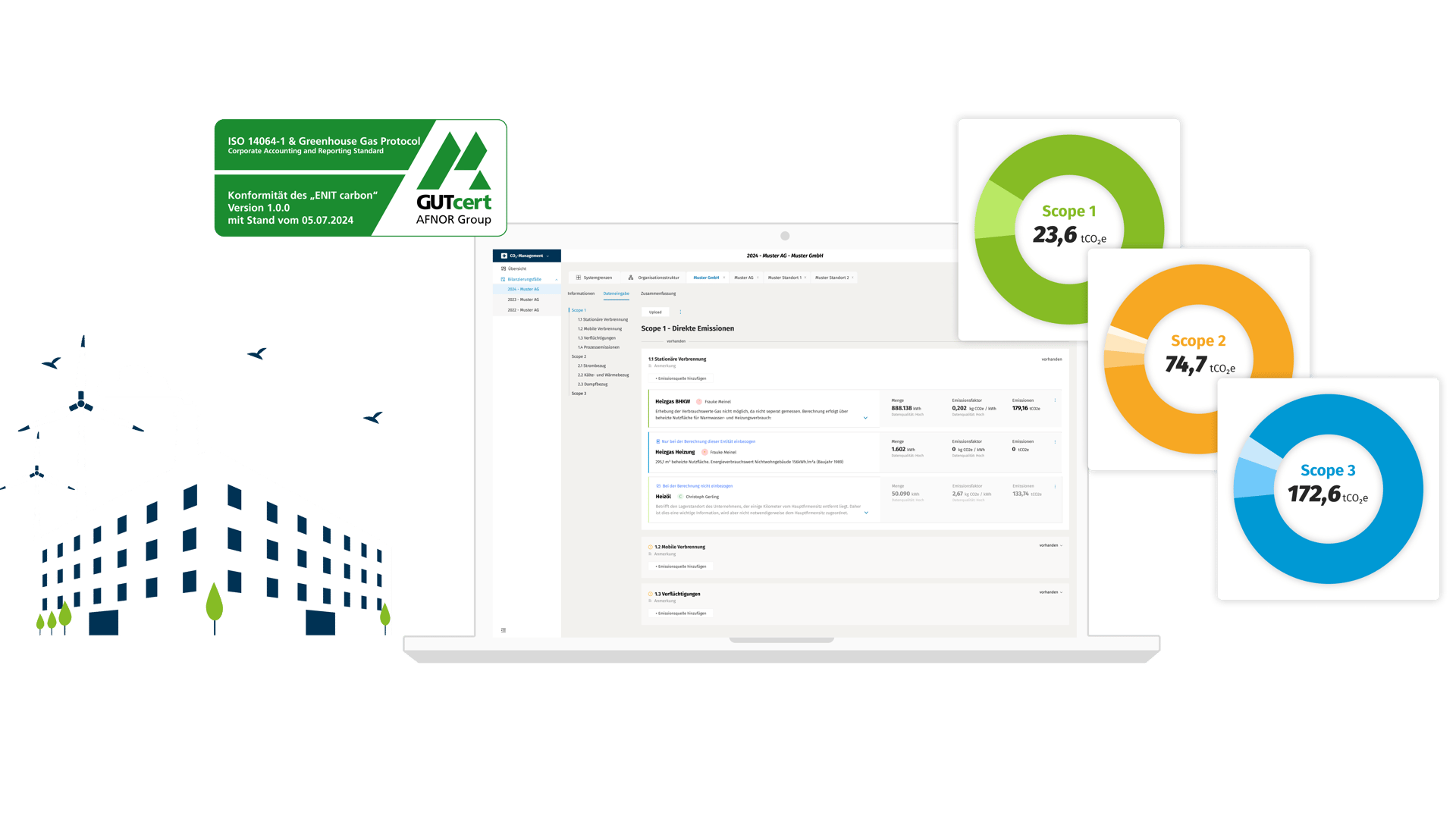
CO2 recording is a central element of the VSME. With our software, you can record Scope 1, 2 and 3 in accordance with the GHG Protocol - transparently, verifiably and efficiently.
"CO2 demo"
Start your free test phase now and record VSME-compliant CO2 data.
For test access, simply contact us using this "CO2 demo" contact form or make an appointment directly.
The VSME (Voluntary Sustainability Reporting Standard for SMEs) is a voluntary ESG reporting framework developed specifically for SMEs. More and more customers, investors and business partners are demanding sustainability information from industrial SMEs. The VSME offers a structured, low-effort solution that is compatible with CSRD/ESRS and tailored to the reality of small and medium-sized enterprises.
On the safe side with little effort.
The EU is planning to extend the VSME standard to companies with up to 1,000 employees as part of the Omnibus Regulation. In future, large companies will only be allowed to request ESG information from their suppliers in VSME format.
What does this mean in concrete terms?
The VSME (Voluntary Standard for Sustainability Management and ESG) offers medium-sized companies in particular a practical basis for structured sustainability management and ESG reporting:
VSME (Voluntary Standard for Sustainability Management and ESG) is a voluntary ESG standard for companies - especially for SMEs. It offers a pragmatic, streamlined alternative to the EU's statutory CSRD (Corporate Sustainability Reporting Directive).
Main differences at a glance:
| Feature | VSME | CSRD / ESRS |
| Binding nature | Currently voluntary | Legally binding (from 2025/26 ) |
| Target group | Medium-sized companies, SMEs | Large companies, capital market-oriented companies |
| Form requirements | Clear structural templatebut not a mandatory format | Reporting in accordance with ESRS, machine-readable |
| Audit obligation | No | Yes, mandatory audit by auditor |
| Scope | Focused on material ESG KPIs | Complete sustainability report incl. strategy, governance, risks, etc. |
| Cost expenditure | Low | High (consulting, data management, audit ) |
The term ESG generally stands for "Environmental, Social & Governance" - i.e. for the three central areas of sustainability that are considered and reported on in companies. VSME is a concrete standard that brings these ESG topics into a practical, SME-friendly reporting format.
The difference lies in the structure and practicability:
In terms of content, the VSME standard focuses on
Both VSME and ESRS are used to prepare ESG reports - but they differ significantly in terms of their objectives, binding nature and complexity.
ESRS (European Sustainability Reporting Standards) are the binding framework for the implementation of the CSRD - they define in detail how companies in the EU must report on sustainability in future. The basic structure of the VSME is based on the ESRS, but was developed specifically for SMEs and is much leaner and voluntary.
Key differences at a glance:
Modules and structure of the VSME standard
The VSME standard has a modular structure and offers companies a flexible, practical basis for ESG reporting - tailored to different company sizes and requirements.
Modules of the VSME
The standard consists of two modules that can be combined depending on the objectives and information requirements:
Content structure
The content of the VSME is based on the structure of the ESRS (European Sustainability Reporting Standards), but remains deliberately leaner, easier to understand and suitable for SMEs. The structure is divided into four subject areas:
Important notes on application
The VSME standard was developed as a voluntary sustainability framework specifically for small and medium-sized enterprises (SMEs). The aim is to create a practical and practicable alternative to the complex statutory ESG reporting obligations - in particular the CSRD.
It was created in response to the increasing excessive demands placed on many SMEs by new regulatory requirements. The VSME enables these companies to record relevant ESG data in a structured and comprehensible manner - without high costs, bureaucratic hurdles or auditing obligations.
Originally designed for companies with fewer than 250 employees, the VSME is now aimed at all organizations that want to voluntarily create transparency - e.g.towards customers, banks or as part of supply chain requirements.
Even though the VSME standard is currently voluntary, we strongly recommend that companies apply it at an early stage. Because:
Our conclusion:
If you start today, you will create advantages tomorrow - through clear data, structured processes and better positioning in competition. VSME creates awareness and makes the company more resilient - in the face of climate risks and growing expectations of transparency and responsibility in its own actions.